Websites for local service businesses
Websites built around how local customers actually choose.
Your website sits between someone finding your business and deciding whether to call. LeadSink makes that decision easier with clearer messaging, a stronger mobile experience, and connected paths for quotes, calls, and follow-up.
- Fixed project scope
- Mobile-first
- You own the finished website
- Based in South Florida
The decision layer
The website does not create every opportunity. It determines what happens to the attention you already earned.
A customer may find you through Google, a review, an advertisement, a referral, or a truck in their neighborhood. The website's job is to confirm relevance, reduce doubt, and make the next step obvious before that customer chooses someone clearer.
- Step 1
Found
Search, reviews, ads, referrals.
- Step 2
Understood
Service and location are immediately clear.
- Step 3
Trusted
Proof answers the customer's hesitation.
- Step 4
Contacted
Call, quote, or consultation fits the job.
- Step 5
Followed up
The inquiry reaches a real process.
Most local customers are trying to answer four questions quickly.
The site structure, messaging, proof, and calls to action should answer those questions in the order customers actually ask them.
Do you handle my exact problem?
Do you work in my area?
Can I trust you with the job?
What happens if I contact you?
The three-part system
One website foundation, built through three connected disciplines.
Clearer messaging
Make the service, location, value, and next step understandable within seconds.
Stronger digital experiences
Give mobile visitors a fast, credible experience that is easy to scan and act on.
Connected marketing systems
Connect forms, calls, analytics, follow-up, reviews, and future campaigns to the website foundation.
The website foundation
Start with the part every other channel depends on.
LeadSink builds the website foundation that search, reviews, referrals, advertisements, and future campaigns can confidently send people to.
Not every item is automatically included. Final scope depends on the business and the project.
Typical scope
- Customer and service-priority discovery
- Homepage messaging and structure
- Priority service pages
- Service-area clarity
- Mobile-first design
- Trust and proof placement
- Call and quote paths
- Frequently asked questions and objection handling
- Basic on-page SEO structure
- Analytics and conversion-event foundation
- Lead-routing recommendations
- Google Business Profile alignment checklist
When the business needs more than pages
The inquiry should have somewhere to go.
When appropriate, LeadSink can connect simple systems that help the business acknowledge, track, and follow up with website interest. These are scoped according to actual operational needs, not sold as a bloated software bundle.
LeadSink can build the connection. The business still needs a reliable person and process responsible for responding.
Different services require different next steps.
Urgent service
Call-first design, immediate service-area confirmation, honest availability, and the shortest responsible path to contact.
Example CTA: Call now
Estimate-driven service
Service qualification, project proof, pricing variables, and a short quote request that gathers only useful information.
Example CTA: Request an estimate
Consultation-based service
People, process, privacy, expectations, and a lower-pressure path to an initial conversation.
Example CTA: Schedule a conversation
Not every client needs all three.
Website concepts
See the system applied to different customer decisions.
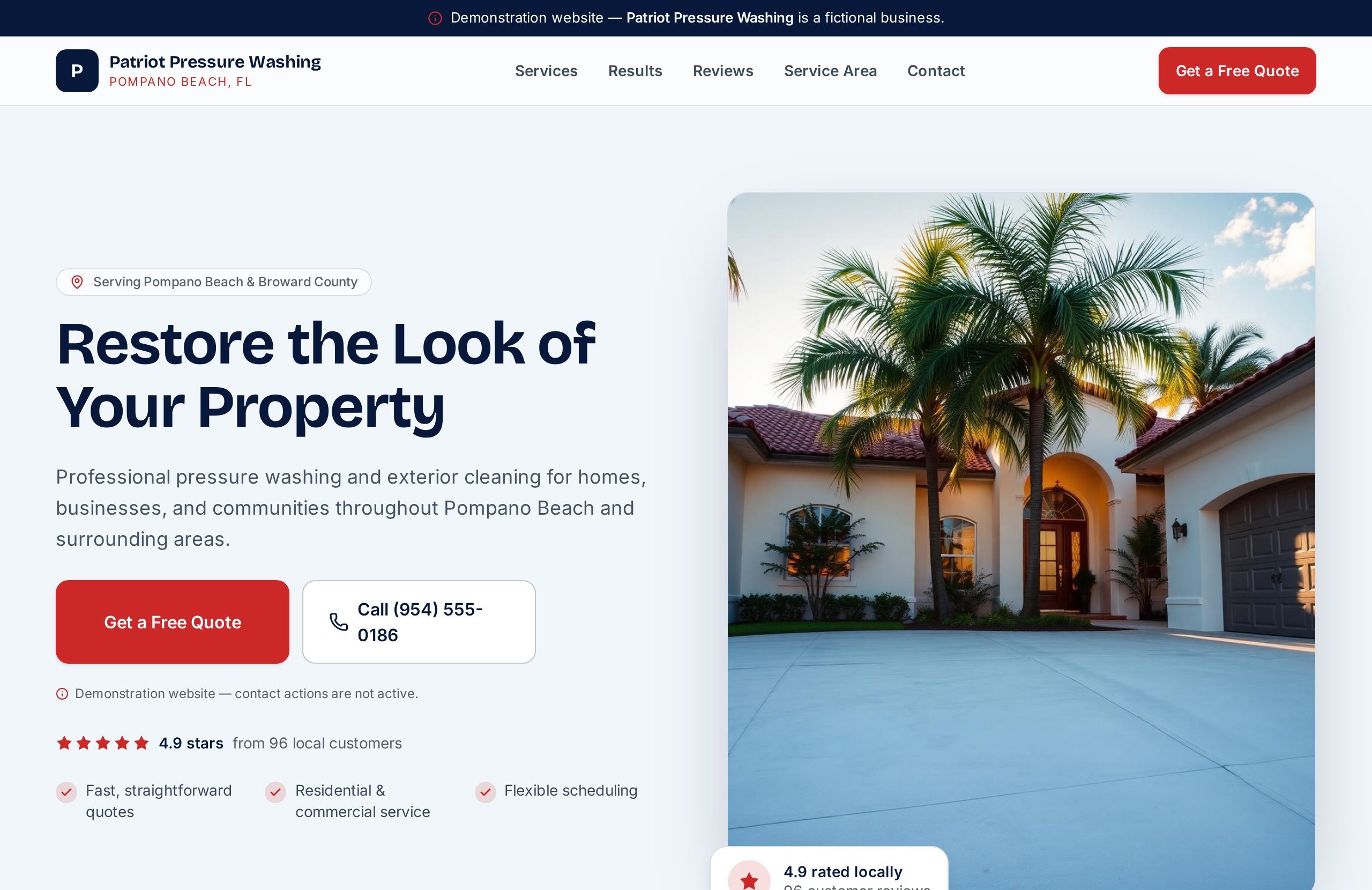
These independent concepts demonstrate how the message, proof, structure, and next step should change with the service. They are not client engagements, and no performance results are claimed.
Independent concept · Estimate-driven service
Patriot Pressure Washing
How a local pressure-washing business could help homeowners confirm the service, location, credibility, and next step within seconds of landing on the site.
Process
A short path from first message to defined project.
Homework first, opinion second, scope last.
Step 1
We see what customers see.
We review your website, services, messaging, reviews, and contact paths to identify what builds confidence and what may be costing you opportunities.
Step 2
We talk through the problem.
We discuss what is working, what is not, how customers currently find you, and what needs to happen after they contact you.
Step 3
We recommend the next move.
That may mean a new website, a focused redesign, a landing page, or a smaller fix. You will get a clear recommendation either way.
Step 4
We define the project.
If we are a good fit, we outline the scope, price, timeline, responsibilities, and measurement plan before work begins.
What the website can fix, and what it cannot.
The website can improve
- Message clarity
- Service and location relevance
- Mobile usability
- Credibility presentation
- Calls to action
- Lead capture
- Measurement readiness
- Connection to follow-up systems
The website cannot replace
- Customer demand
- Competitive pricing
- Strong reviews
- Fast response
- Sales follow-up
- Quality service
- Operational capacity
The strongest website reflects a business that is ready to support the promise it makes.
See what your customers see
Find the point where the decision gets harder than it should be.
Send your current website and a few details about the services you want to grow. LeadSink will review the message, mobile experience, trust signals, and contact path, then recommend the clearest next step.